


New Study Same Bias: Colorado Researcher Yet Again Fails to Demonstrate Link Between Energy Development and Health Outcomes
An academic with a long history of publishing questionable and heavily criticized research targeting the oil and natural gas industry, is out once again with more deeply flawed research. In the latest iteration, Dr. Lisa McKenzie, a professor at CU’s School of Public Health, attempts to connect residential proximity to oil and natural gas production with instances of childhood leukemia.
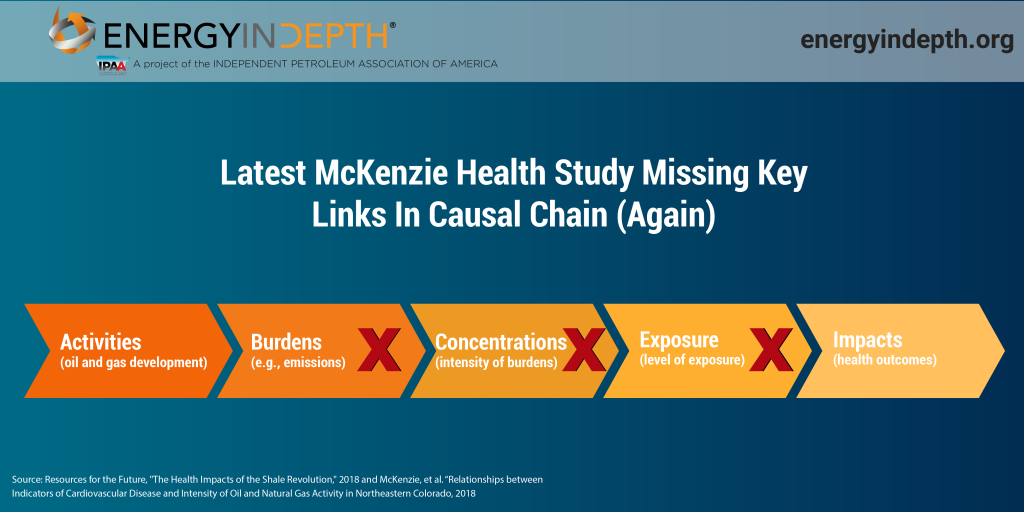
Spoiler Alert: By its own admission, the report fails to establish any causal connection between childhood leukemia and oil and gas production – a fact Dr. McKenzie acknowledged in comments to Colorado Public Radio:
“The study did not identify the cause of the increase in leukemia risk, or how exposure to certain chemicals contributes to cancer development. McKenzie said those topics deserve further research. There might also be other ‘confounding’ factors that the study did not fully account for, which could complicate the relationship between oil and gas drilling and cancer risk.
‘We don’t have the data to actually say for example, how much benzene each one of these children were exposed to,’ McKenzie said. ‘We’re just looking at the overall density of oil and gas development, so we don’t know specifically what it is that might be causing childhood leukemia.’” [emphasis added]
Commenting on similar childhood leukemia research that Dr. McKenzie published in 2017, Colorado’s former Chief Medical Officer, Dr. Larry Wolk, made this exact point, noting that finding a “possible association” “does not prove or establish” a connection to oil and gas operations.
Research Relies on Major Assumptions to Reach Its Conclusions
The report contains a number of other limitations, including the assumption that a child’s birth address represented their true exposure over time. The researchers tracked oil and gas activity around the location where the mother resided at the time of the child’s birth, and then assumed the child had that same environmental exposure from pregnancy through age of diagnosis. This is despite the fact that nearly half the mothers moving throughout the course of the study. Yet, due to data limitations and concerns about bias, the authors ultimately “assumed that [the] address in the birth registry represented a child’s residence over the entire exposure period.” The use of a single address as a stand-in for years of exposure is highly questionable, and it potentially muddied the results.
Closely related to the lack of direct exposure data is the study’s inability to account for other factors that could explain the observed association. Childhood leukemia is a complex disease with many potential influences, including genetics, and household exposures. Yet, by focusing narrowly on oil and gas, the study may be ignoring “a lot of alternative explanations,” as Dr. Mike Van Dyke of the Colorado Department of Public Health and Environment (CDPHE) cautioned about the earlier 2017 study.
Activists Use McKenzie Study to Make False and Incendiary Claims
Despite these obvious limitations, Dr. McKenzie’s report is already being spun by activists as conclusive proof that energy production causes childhood cancer. A number of anti-energy activists cited Dr. McKenzie’s research in a recent Colorado Energy and Carbon Management hearing to consider a series of proposed wells in Erie, Colorado, with some spuriously alleging that approval of Civitas’s Draco project in Erie would amount to “killing” children. One activist went so far as to claim that Dr. McKenzie’s new study conclusively proved that 451 Colorado children were diagnosed with cancer as a result of oil and gas development.
Of course, Dr. McKenzie’s research – at her own admission – makes no such claim or association. Nonetheless, that kind of incendiary rhetoric demonstrates exactly how activists routinely leverage Dr. McKenzie’s research to make outlandish claims and sow misinformation.
ECMC regulators were not swayed, and approved Civitas’s application, with one member commenting “this is one of the best applications ever to come before us.”
Researcher’s History of Bias
As Energy In Depth has documented previously, Dr. McKenzie has a large portfolio of research that makes similar claims and has consistently drawn public criticism, in large part due to her previous studies using location as a proxy for exposure without actually conducting any monitoring and repeatedly failing to establish a causal relationship between energy production and health outcomes.
Instances of Dr. McKenzie’s questioned research include:
- A 2014 study where Dr. McKenzie claimed to find the “an association between those who lived within a 10-mile radius of (oil and gas development) and congenital heart defects and possibly neural tube defects.”
- The Colorado Department of Public Health and the Environment responded to the study with the statement: “[W]e disagree with many of the specific associations … [and] a reader of the study could easily be misled to become overly concerned.”
- The aforementioned 2017 study where Dr. McKenzie claimed to find an association between oil and natural gas development and childhood cancer.
- CDPHE responded to the study with the statement: “We support studies that evaluate the potential impact of environmental contaminants on public health, and certainly, Benzene exposure has been proven to increase risk of certain types of cancers, including leukemia. However, this study’s conclusions are misleading in that the study questions a possible association between oil and gas operations and childhood leukemia; it does not prove or establish such a connection.”
- A 2018 study where Dr. McKenzie claimed to find the “lifetime cancer risk of those living within 500 feet of a well was eight times higher than the EPA’s upper level risk threshold.”
- CDPHE’s former Chief Medical Officer and Executive Director, Dr. Larry Wolk responded to the study with the statement: “This study confirms our 2017 findings of low risk for cancer and non-cancer health effects at distances 500 feet and greater,” referring to the 2017 CDPHE Report: Assessment of Potential Public Health Effects from Oil and Gas Operations in Colorado, which found, based on 10,000 air samples, a “low risk for cancer and non-cancer health effects at distances 500 feet and greater.”
- A 2022 study where Dr. McKenzie sought “to determine if residents living near [unconventional oil and gas development] sites within [City and County of Broomfield] experience a greater frequency and number of health symptoms than residents living at further distances.”
- Shortly after the study’s preliminary results were release without a peer review, CDPHE issued a statement highlighting the many shortcomings of the research: “Surveys of this nature contribute to the scientific evidence by identifying potential public health concerns that may need further investigation, but there are limitations, as there is with all research. (As) the survey authors note, self-reported outcomes can make it difficult to assess the extent to which perceptions about oil and gas activity influence participation in the survey and responses to survey questions.” (emphasis added)
BOTTOM LINE: No matter how the results are spun, correlation is not causation, and Dr. McKenzie’s latest research appears to be yet another hypothesis chasing a headline that should be treated with appropriate caution and skepticism.

