


Analysis: Multnomah County Gas Stove Report Based on Flimsy Arguments, Flawed Research & Lack of Transparency
Today, Energy in Depth is releasing a new analysis of an Oregon county health report released in November that claimed gas stoves are a “health hazard” and recommended residents replace the popular cooking appliances with electric stoves.
But after a detailed citation by citation breakdown, EID’s analysis shows that the factual basis of Multnomah County, Ore.’s report is flimsy, lacking, and is not nearly as robust as would be expected for a governmental mandate that will severely restrict consumer choices for nearly one million Oregon residents. The report itself conducts no new research and analyzes only a handful of questionable studies.
This report is the first from a government agency to use health claims to justify restricting natural gas stoves, a staple of millions of American homes and an appliance that a recent Morning Consult poll found is still the favored choice when compared with electric.
The county indicates its report “summarizes some of the most recent health evidence on gas stoves and their impact on health, reviews case studies of policy action, and offers public health recommendations.” But the report relies on questionable studies – several of which Energy In Depth has reviewed previously – while ignoring a myriad of other factors that determine indoor air quality, such as road vehicle emissions, air rate exchange, climate, weather conditions, and occupant behavior while neglecting to examiner proper ventilation, a key component in examining indoor air quality. As a result, the conclusions of the report raise questions as to the transparency and reliability of Multnomah County’s data.
As EID noted last month, this report, which is essentially a literature review, is part of a broader national strategy driven by “Keep It In the Ground” groups that has resulted in cities and counties across Oregon aiming to ban consumer access to natural gas with seemingly little efforts to educate the public. It is also unclear how much support these extreme measures have among Oregon residents. Further, it appears the report was conducted without consultation from local businesses or industry, including county residents experienced in installing residential and industrial ventilation.
EID’s analysis shows that the factual basis of the report is flimsy, lacking, and is not nearly as robust as would be expected for a governmental mandate that will severely restrict consumer choices for nearly one million Oregon residents.
Read the full analysis here.
Key Findings
- The report relies heavily on flawed studies with improper methodologies that have been
questioned publicly.- For example, a key study used in the report sealed their test kitchen in plastic tarps, therefore creating an unrealistic environment. As Daniel Tormey, president of Catalyst Environmental Solutions said: “The study results are useless for evaluating health-based exposures because no kitchen is set up like that. In other words, they weren’t simulating a real-life cooking experience.”
- Literature review does not provide information on exposure and concentrations, meaning it’s not possible to determine if there is a health threat.
- As Dr. Julie Goodman, a fellow of the American College of Epidemiology and Academy of Toxicological Sciences, explained in her testimony to the Multnomah County Commissioners on the report: “The presentation lists many health effects associated with pollutants, generally. But there is no discussion of the concentrations at which any of these effects could occur. Chemicals do not cause harmful effects unless they are at a dose high enough to overwhelm the body’s normal biological processes. And so, what this means is that the mere presence of an air pollutant doesn’t indicate an increased health risk. And without a consideration of concentration or dose, it’s not possible to determine whether exposures could be harmful.”
- Data show that most pollutant emissions come from cooking food, regardless of the type of
cooking appliance.- The county report largely glosses over a key component of indoor air quality endorsed by academics, the EPA, and the Sierra Club: proper ventilation. As the California Air Resources Board’s website on indoor air pollution and cooking explains: “Cooking can also generate unhealthy air pollutants from heating oil, fat and other food ingredients, especially at high temperatures… Studies show that air can be unhealthy to breathe when people cook in kitchens with poor ventilation. The best way to ventilate your kitchen is to use a properly-installed, high efficiency range hood over your stove.”
- This was acknowledged during the county health department’s presentation on the report when one commissioner questioned why her VOC monitor would go off while cooking despite her having no gas appliances in her home.
- The report claims to be a literature review but curiously omits the most complete analysis to date
on the subject.- In contrast to Multnomah County’s claim, the International Study of Asthma and Allergies in Childhood – the largest and most complete analysis to date examining any potential link between gas appliances and childhood asthma – found “no evidence of an association between the use of gas as a cooking fuel and either asthma symptoms or asthma diagnosis.” The Multnomah County report neither cited nor referenced this study.
- A predominant study used to buoy the report was funded by environmental activists with a history of “advocacy” research.
- PSEHE’s Executive Director wrote a memo on how to use headline-generating health research while its co-founder has bragged that his research is “a form of advocacy.”
- Among PSEHE’s funders is the Park Foundation, which supports a “Keep It In The Ground” agenda and “resisting all new gas and oil drilling.”
- The report analyzes a limited number of sources on indoor air quality and even fewer that look at potential impacts from gas stoves.
- Of the 43 research citations (39 unique sources) used by the county health department, only 9 of the resources focused on general indoor air quality in the United States, while 22 focused on broader topics such as outdoor air quality or environmental justice. Worse, fewer than one-third of the citations relate to indoor air quality, and among those the report utilized only eight unique sources directly relevant to indoor air quality and gas stoves.
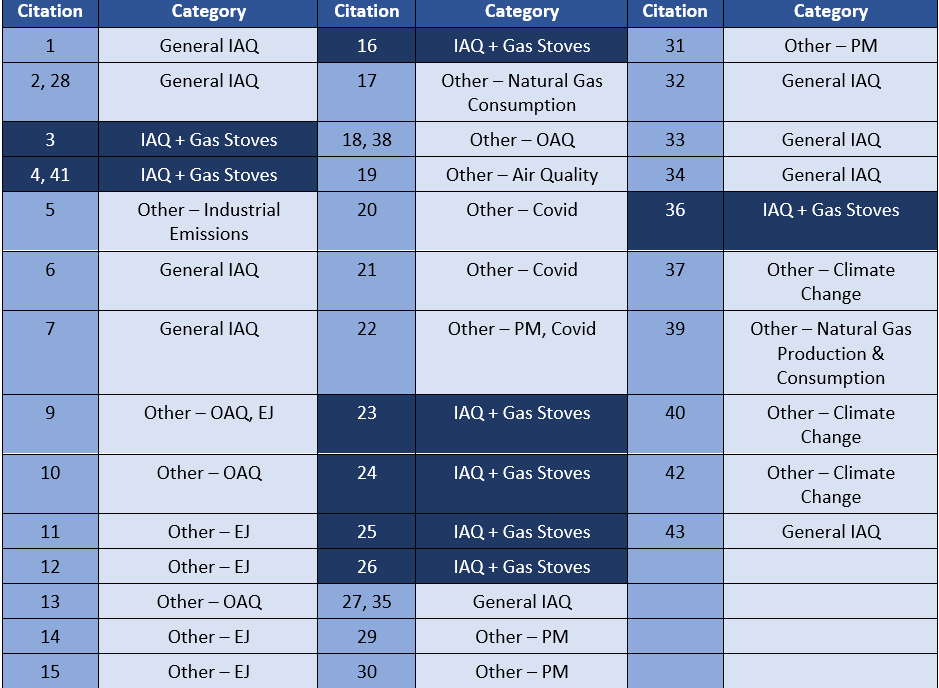
*Note: Indoor Air Quality (IAQ); Outdoor Air Quality (OAQ); Environmental Justice (EJ); Particulate Matter. **Sources cited twice are shown as such in the chart.
Read EID’s full analysis here.

