


Newspaper Column Falsely Attempts to Link Fracking to Low Infant Birth Weight
A recent syndicated column appearing in newspapers around the country provides the latest example of relying on fear-mongering tactics – instead of facts – when talking about fracking and health concerns.
An “Ask the Doctor” column written by two doctors, Eve Glazier and Elizabeth Ko, purportedly responds to a reader from Ohio asking whether she should be concerned about getting pregnant while living near oil and natural gas operations.
The doctors don’t appear to have any specific expertise in energy, environment, or public health themselves, so they instead cite a flawed 2017 study conducted by researchers at Princeton University, University of Chicago, and University of California at Los Angeles who tried to connect fracking to low birth weights in Pennsylvania newborns.
The study is filled with numerous caveats that the researchers’ data can’t prove that fracking is the cause of any poor birth-related health outcomes. Nonetheless, the Glazier-Ko column is topped by this misleading headline: “Study links fracking to low birth weight.”
That’s a bold claim considering the doctors concede the study doesn’t prove it:
“Although the study correlates proximity to fracking sites with low birth weight, it doesn’t explain what is causing these outcomes. The authors agree that more information is needed and have said they hope their study will lead to further research.”
Main Finding of Study Contradicts Topline Conclusion
The study was published with the premise that women living near oil and natural gas operations tend to have a greater likelihood of having a baby with low birth weight. But as the following graphic from the third page of the study illustrates, the researchers found mothers who live 2-3 kilometers away from production sites are actually more likely to have babies with low birth weights than those who live 1-2 km away.
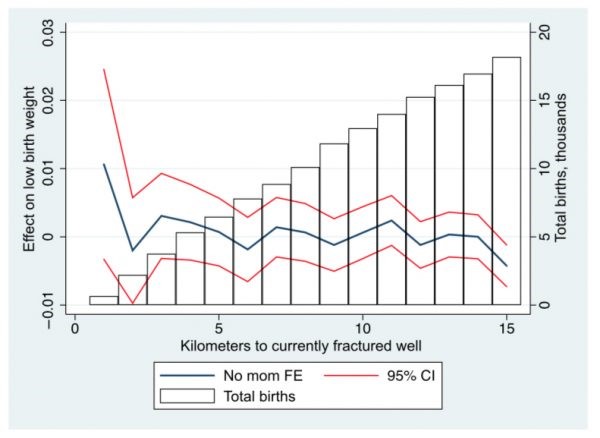
As the caption for this graphic explains,
“The left y axis of the graph indicates coefficients and confidence intervals (CIs) from a version of Eq. 1 in which ‘Near’ is replaced with 15 distance indicators representing the proximity of maternal residence to well sites; the coefficients represent the in utero effect on infant health of hydraulic fracturing (that is, when conception occurs after well spud date) at 1-km intervals from the well site…”
The chart clearly shows that the risk for low birth weight drops significantly in the 1-2 km bar (second from the left) and then sharply rises in the 2-3 km bar. There is no explanation as to why the data show mothers farther away from fracking sites have a higher risk than those who are closer.
Lack of Evidence and Certainty
The study claims that “new evidence” links hydraulic fracturing to infant health in Pennsylvania. But buried near the end, the authors list several disclosures that expose their lack of evidence.
The first is that there is no hard evidence, rather just circumstantial data:
“A limitation of our study is that given the nature of the available data, we are constrained to focus on potential exposure to pollution (which is determined by the mother’s residential location) rather than actual exposure that could be measured with personal monitoring devices.” (emphasis added)
Another problem is the accuracy of the data and small sample sizes:
“A second limitation of our study is that even starting with the whole population of Pennsylvania births, we end up with a relatively small sample of children who were potentially exposed to fracking; this small effective sample size limits our ability to probe the shape of the distance-exposure relationship and also limits our ability to obtain precise estimates from models with mother fixed effects.” (emphasis added)
Finally, the researches don’t express much confidence in their own study:
“A third caveat is that the pathway of exposure was not a subject of our study and is not known with certainty. The results of our study are consistent with the possibility that very local air pollution, perhaps from the multiple diesel generators used at well sites, from chemicals used in fracking, or even from truck traffic to and from sites, could be a potential key source of exposure. Previous research regarding human health effects of exposure to hydraulic fracturing has also identified contaminated water as a possible pathway. Although industrial activity from hydraulic fracturing and improper disposal of fracturing fluids can affect water quality, recent analyses suggest that it is not common for fracturing fluids to leak into surface water from the fractured well sites.” (emphasis added)
Further, there are many factors that contribute to low birth weight in infants, including mothers smoking cigarettes, using illicit drugs, high blood pressure, diabetes, and poor nutrition, according to the Mayo Clinic. The study relies on birth certificates that may or may not contain any of that information about mothers.
Ohio-specific studies find no issues
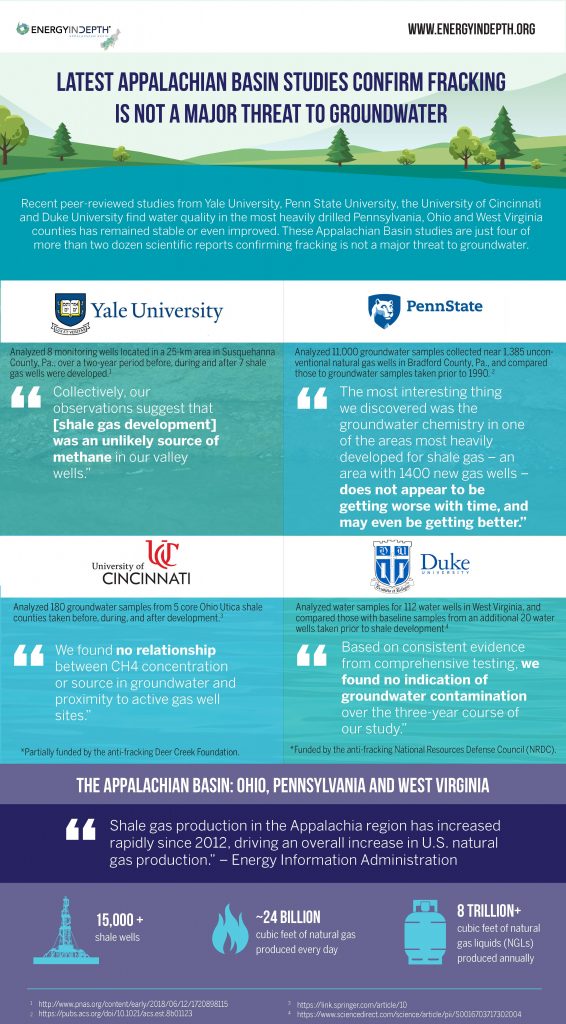
In contrast to this study and others, the University of Cincinnati has conducted groundwater and air quality studies that have found no impacts in some of Ohio’s most heavily developed counties.
UC’s groundwater study “did not document that fracking was directly linked to water contamination,” while its air quality study found that “none of the air sample averages exceeded EPA levels of health concern” after being evaluated for 63 volatile organic compounds (VOCs) and formaldehyde.
Yet neither of these studies were mentioned, despite the findings being in line with similar research conducted in the region:
Conclusion
Energy In Depth published a deeper dive on the Univ. of Pittsburgh study’s flaws in 2017.
Sadly, studies continue to be published with definitive headlines linking fracking to poor health outcomes, but containing data that contradict the headline.
It’s irresponsible for scientists to continue to publish such studies, for doctors without expertise in the field to cite them in response to questions around oil and natural gas development, and for newspapers to print it as accepted fact.

